This content was first published on IGR – Italian Gemological Review no. 3 in 2018. The information provided here is therefore current as of the original publication date.

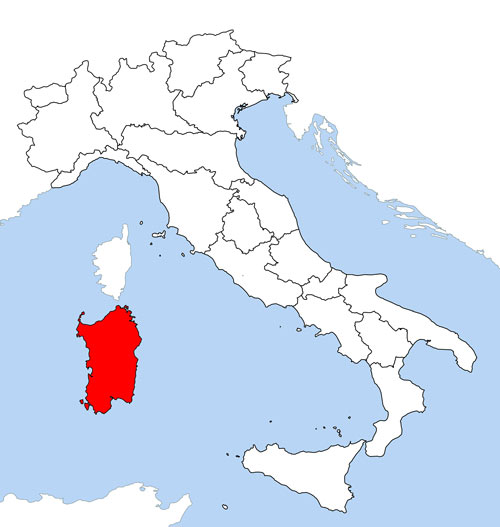
Although barite is common in various locations and mines in Sardinia, the variety of Villamassargia, in the province of Carbonia-Iglesias, is particularly famous. It can be found in tubular crystals of great sizes, often over 10 cm, of a yellow ranging from amber to brown (Figure 21).
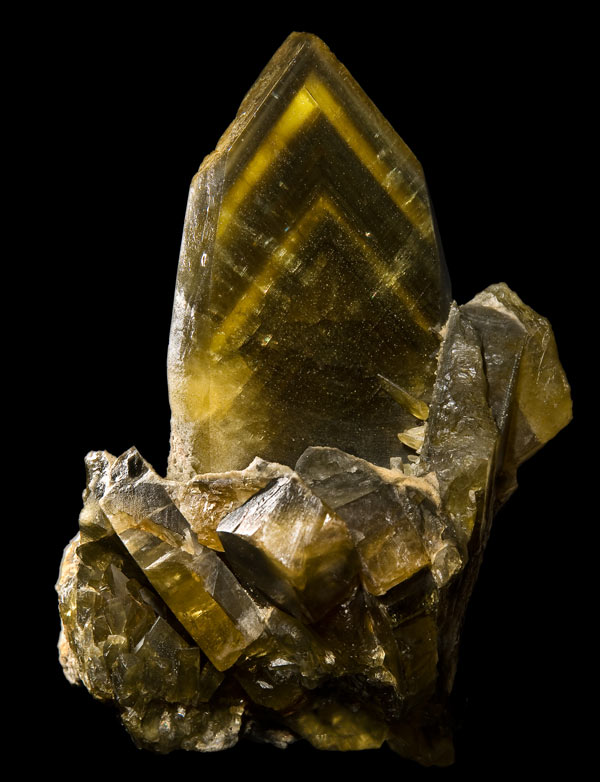
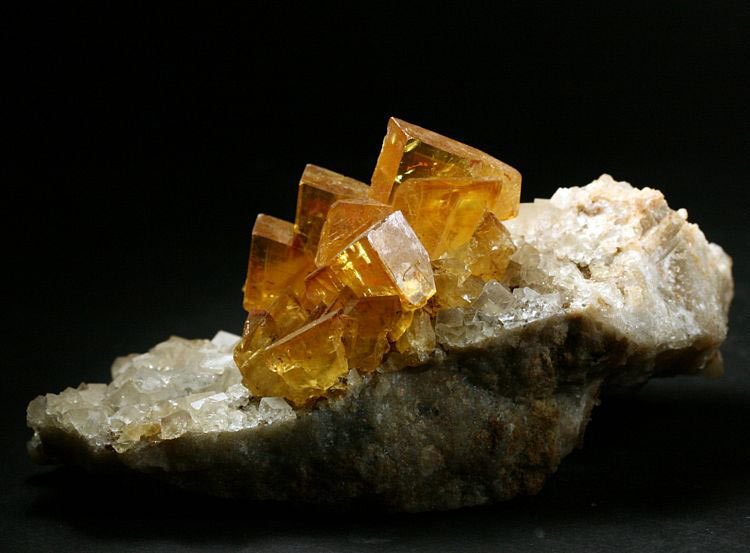
Barite crystallisations are located on the Monte Mesu hill, near Villamassargia where we can find some of the most important mines of barite in Sardinia, now all closed. Most of the collection samples was extracted in the second half of the ‘70s, but good quality items can be still extracted today.
From the point of view of collection samples, they extracted big size pieces, though often not very elegant, as the crystals show a dark and a bit dirty outer surface.
From the point of view of the cutting material, these barites are undoubtedly the best in the world as for colour and size. It is not a rare event that the nucleus of big crystal characterised by a cloudy and dark appearance, is composed of a core of yellow and clear barite. In the outer parts of the crystal the repetition of dark phantoms makes the material not suitable for cutting.
The colour is quite homogeneous characterised by a straw yellow hue.
Cutting barite is extremely difficult due to its low hardness, 3-3.5 on the Mohs scale and to the possibility of having an easy parallel cleavage at the basis and at the faces of the prism. The raw item breaks in a way similar to calcite in cleavage crystals with a rhomboidal shape and it is then easy to isolate the cutting parts.
As it contains barium, barite is a very heavy stone with a 4.48 g/cm3 density. It is a positive biassic stone with indexes: nα = 1,634–1,637; nβ = 1,636–1,638 and nγ = 1,646–1,648. The birefringence is very high, equal to 0.012.
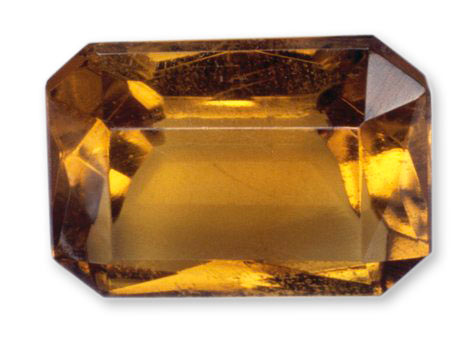
Crystals of Sardinian barite of remarkable sizes can be found from which gems greater than 100 carats were cut, usually characterised by a warm hue ranging from yellow, to brown and honey yellow. The transparency is on average high and stones without inclusions visible at the naked eye are quite common; the defects typical of the barite gems are: various types of liquid inclusions, colour zoning, sheets of cleavage and cracks.
Despite its being a soft stone interesting only to collectors, thanks to its optical properties, faceted barite is a gem endowed with a rare beauty (Figure 22).
Visit the Gems of Italy section!
Curated by the qualified group of expert of the section Gems of Italy, published on IGR – Italian Gemological Review #3, January 2018.