This content was first published on IGR – Italian Gemological Review no. 7 in 2019. The information provided here is therefore current as of the original publication date.

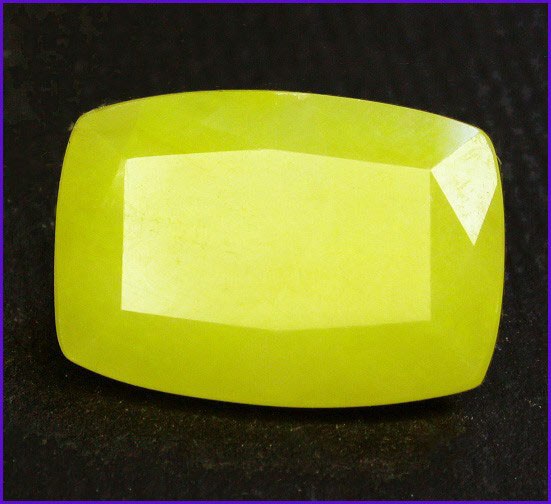
Smithsonite is zinc carbonate with formula ZnCO3, a mineral very much sought after by collectors for the wide range of colors that it can exhibit, pink, blu, yellow, green. Nonetheless dice it is rarely found in crystals, it is not generally a species of gemological interest. It’s yellow variety from Sardinia is an exception for its impressing yellow color making it a desirable bite for all collectors (Figure 105).

www.cfm-minerals.it.
In the mine of Masua near Nebida, Iglesias-Carbonia province, smithsonite is found in stalactitic and botryoidal structures coating the walls of large karstic cavities. These are Mississippi Valley type deposits, where zinc in the form of oxides, concentrates in large cavities within limestone rocks.
Smithsonite was the main mineral encountered in this mine, for the extraction of zinc, thus large quantities of smithsonite worth cutting have been lost in the past.
Since the mine has been definitively closed in 1993, entrance was strictly prohibited and so new material is not extracted since twenty years. This is why most of the cut grade rough available in the market in the last years comes from private collections or from old miners’ houses where a large yellow block was used as a doorstop.
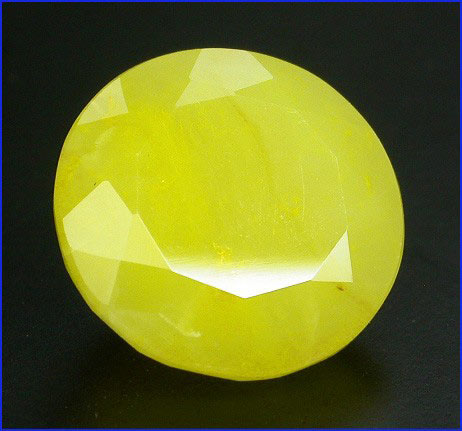
The yellow smithsonite of Masua occurs in fibrous masses showing a lemon yellow or a dirty yellow color with several brown or green tones. It’s yellow color is due to the presence of cadmium. The material is always translucent and therefore the best one for cutting depends only on the color that is expected to be vibrant and shiny. As a consequence the best gems are translucent, intensely and evenly yellow colored (Figure 106), almost always coming from Masua (Cagliari, Sardinia), faceted with a large table and a low pavilion (it’s important to emphasize color rather than dispersion since the gems are never transparent). Low hardness (4-4.5) restricting its use in jewelry and making it a gem attractive just for the market of collectors. The fact that the jain mine is not productive since more than forty years increases its value because of irs rarity.
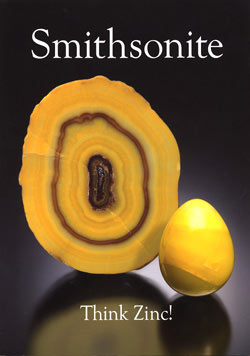
The reputation of yellow Sardinian smithsonite is attested by a special edition cover of the famous magazine Lapis (Figure 107) featuring some very nice, deep yellow Sardinian specimens and the caption “think zinc”.
One more Sardinian mine, the one of Sa Duchessa north of Domusnovas, Iglesias-Carbonia province, produced in the last excellent samples of light blue cupriferous smithsonite. The mine, closed in 1971, offered in the past plenty of nice looking mineral specimens.
Nowadays the light blue smithsonite of Domusnovas (Figure 108) is very difficult to find. At the time of its exploitation it occurred in nice and shiny light blue colored botryoidal incrustations and in fibrous masses.
Along with light blue smithsonite, in the Sa Duchessa mine it was possible to find hemimorphite, a very similar mineral easy to mistake with it and therefore generically named calamina.
Calamina hemimorphite of nice light blue color could be found in the past also in Elba’s mine of Capo Calamita.

www.cfm-minerals.it.

Visit the Gems of Italy section!
Curated by the qualified group of expert of the section Gems of Italy, published on IGR – Italian Gemological Review #3, January 2018.