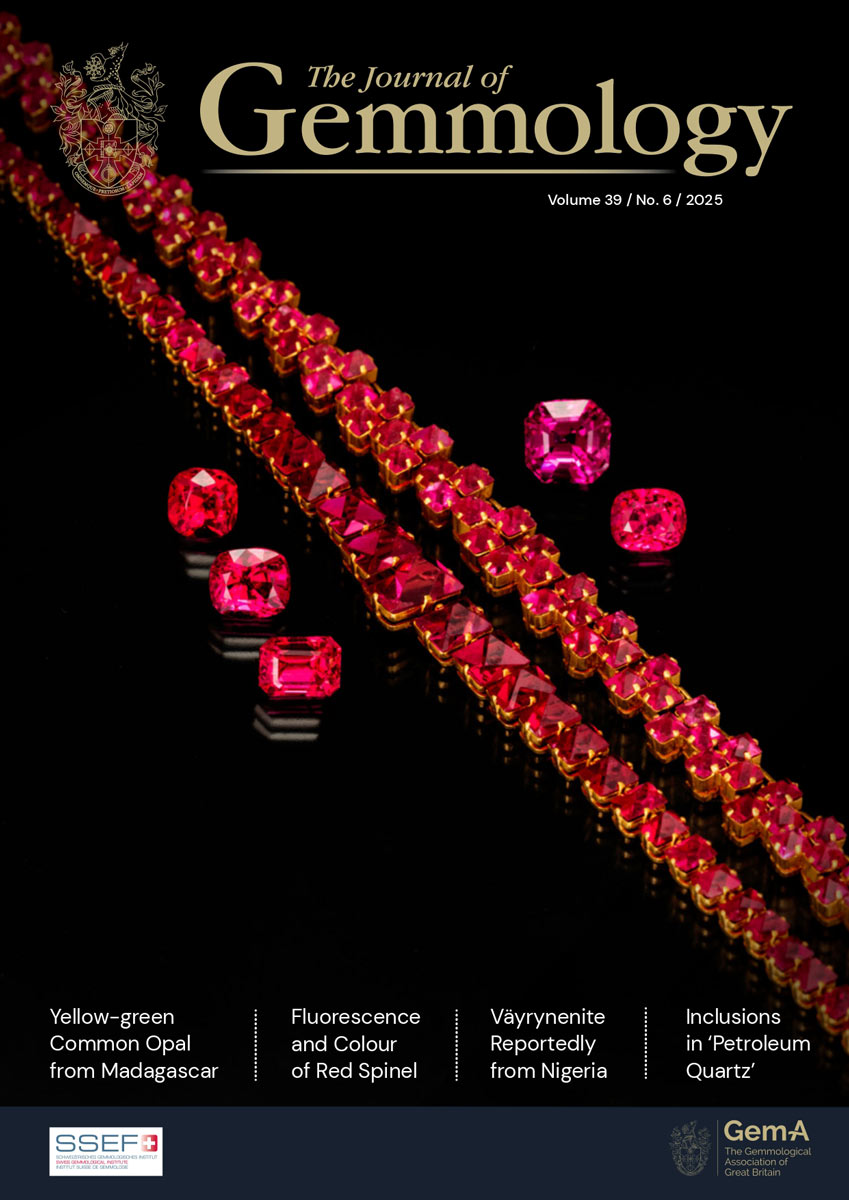
The new issue of The Journal of Gemmology (Volume 39, No. 6, 2025), published by Gem-A in collaboration with SSEF, features a selection of scientific contributions focused on the in-depth study of gemstones. Four main articles showcase four distinct areas of research: the discovery of a new variety of common opal in Madagascar; the complex interplay between UV fluorescence and chemical composition in red spinel from Myanmar; the emergence of exceptional-quality väyrynenite reportedly from a new source in Nigeria; and a high-resolution analysis of multiphase inclusions in so-called “petroleum quartz”.
In the paper “A New Discovery of Common Opal from Antetezambato, North-western Madagascar”, Sara Monico, Ilaria Adamo, Federico Pezzotta, Petra Mácová, Radek Ševčík, G. Diego Gatta, Loredana Prosperi, and Nicoletta Marinoni document the discovery of a variety of yellow-green common opal found in the Antetezambato region of northwestern Madagascar during explorations in search of demantoid garnet. The material, classified as a microcrystalline opal-CT with a predominance of tridimite over cristobalite, owes its color to the presence of iron. Chemical analysis reveals a more homogeneous composition and a higher silicon content than that of Anosy opal. Due to its aesthetic qualities and good durability, this opal lends itself to ornamental and jewelry uses.
In “New Insights into the Factors Influencing the UV Fluorescence and Color of Red Spinel from Myanmar”, Wenxi Zhang, Tao Chen, Xiuhong Liao, Xing Xu, Lili Lou, Xuejun Yan, and Jun Yan conduct an in-depth study on the mechanisms that determine the UV fluorescence and color of red spinel samples from Myanmar. The research shows a complex relationship between chromium and iron concentrations and fluorescence intensity: excessive Cr content (over 25,000 ppmw) results in spinels with a dark red color and weak or absent fluorescence. In contrast, optimal levels of Cr³⁺ promote bright red fluorescence under UV light.
The paper “Väyrynenite of Exceptional Quality and Size, Reportedly from Nigeria”, authored by Michael S. Krzemnicki, Laurent E. Cartier, and Markus Wälle, describes the release of väyrynenite samples of exceptional quality and size attributed to a new source located in central Nigeria. Until now, this rare mineral species has primarily been known from small, included specimens from northern Pakistan. The new Nigerian specimens are distinguished by saturated colors ranging from pinkish orange to deep orange and high transparency, with few fissures. Although gemological properties and UV-Vis-NIR and Raman spectra are consistent with known data for väyrynenite, chemical analyses indicate significant differences between the Nigerian and Pakistani material, particularly in the Fe and Zn contents (higher in the former) and Sc, Y, and REEs (higher in the latter), thus allowing a clear geochemical distinction between the two origins.
Finally, in the study “Characterization of Inclusions in ‘Petroleum Quartz’ with High-Resolution X-ray Computed Micro-Tomography, and Infrared and Raman Spectroscopy”, Yujie Gao, Moqing Lin, Guanghai Shi, and Tiantian Huang analyze the multiphase inclusions found in the so-called “petroleum quartz” by high-resolution X-ray computed micro-tomography (micro-CT), FTIR and Raman spectroscopy. The inclusions contain a yellow liquid, a colorless gas, and a dark solid. The liquid was identified as a hydrocarbon compound by FTIR, while the solid was classified as bituminous asphaltite by Raman spectroscopy. Micro-CT images made it possible to visualize the internal phase distribution in unprecedented detail: more than 91 percent of the volume is occupied by the liquid, less than 8 percent by the gas, and about 1 percent by the solid.
In addition to the main articles, this issue also features several brief yet noteworthy contributions highlighting recent gemological observations from around the world. One update focuses on the Mahenge region of Tanzania, internationally recognized for its high-quality spinel, ruby, and garnet. Recent discoveries of tsavorite in the area further enhance its gemological significance. Another piece examines striking specimens of gold-in-quartz from the McLaughlin Mine in California. Analysis reveals intricate arborescent and reticulated textures, often associated with the presence of stibnite and cinnabar. Finally, an insightful note explores the challenges posed by drilled natural pearls with collapsed cores. This phenomenon — potentially caused by environmental or biological factors — raises important questions and presents complications in gem identification.