The Spring 2025 edition of Gems & Gemology (Volume 61, Number 1) offers an in-depth analysis of some of the key topic in the current gemological landscape. Notable contents include a study of the diagnostic characteristics of corundum, the Winston Red diamond, and an analysis of a Renaissance jewel adorned with emeralds.
In “The 3309 cm-1 Series in Sapphire and Ruby: A Focus on FTIR Peak Position Variation”, Wasura Soonthorntantikul and Aaron C. Palke investigate the correlations between peak positions in the 3309 cm-1 series and trace element concentrations in rubies, metamorphic and basaltic-derived blue sapphires, and laboratory-grown sapphires. The series at 3309 cm-1, consisting of three main peaks at about 3309, 3232 and 3185 cm-1, with two additional weak peaks at 3367 and 3295 cm-1, is of particular interest to gemologists. This series is related to the stretching vibrations of hydroxyl groups that are locally associated with titanium ions in the corundum structure. Its presence may be a diagnostic indicator of post-formation heat treatment for metamorphic blue sapphires, rubies from certain deposits (e.g., Mozambique) and pink sapphires from Madagascar. The study found a positive linear relationship between the positions of the top three peaks in the series and iron concentrations for blue sapphire, or the sum of iron and chromium for ruby. The peaks shift about 1.7–3.6 cm-1 from their minimum positions as iron and/or chromium content increases.
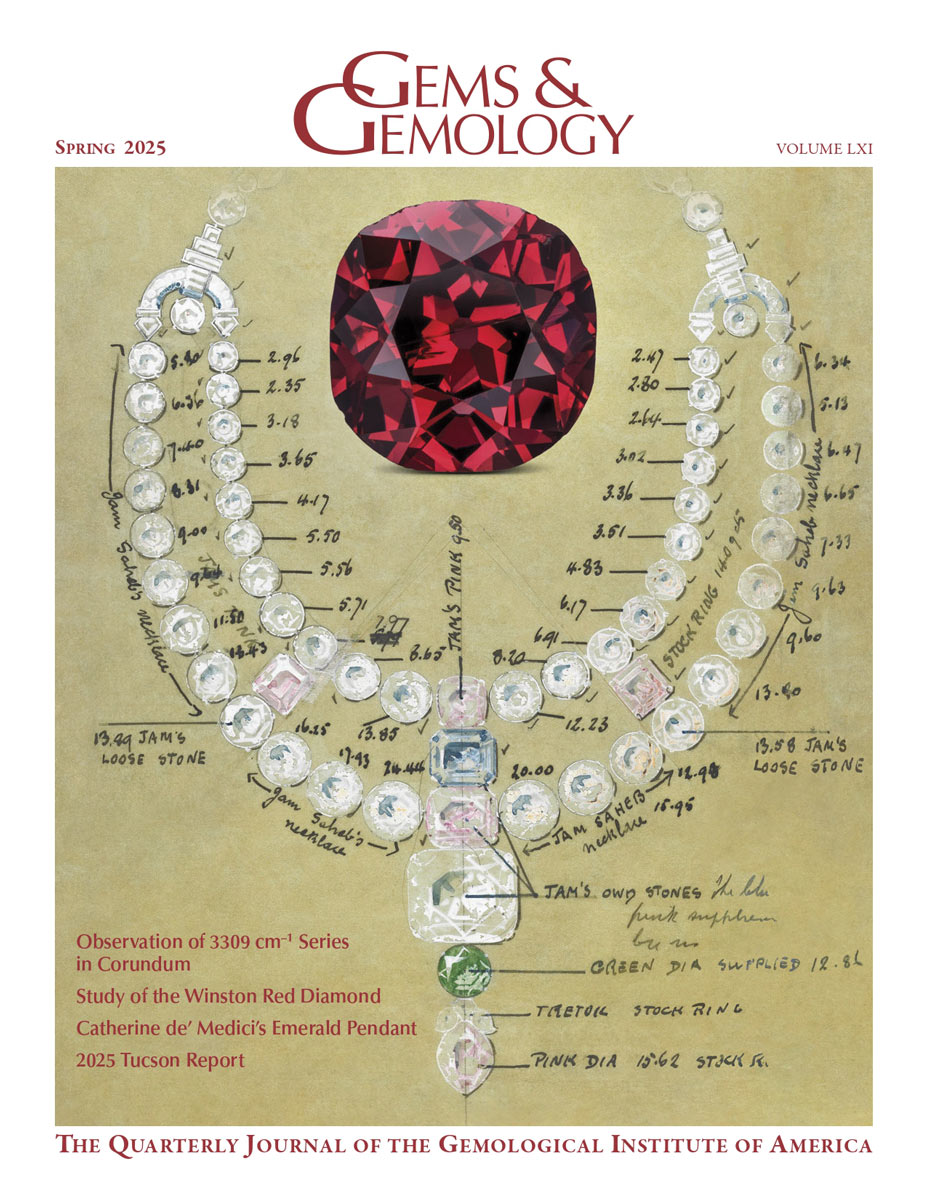
The article “A Study of the Winston Red: The Smithsonian’s New Fancy Red Diamond”, by Gabriela A. Farfan and colleagues, presents the first scientific and historical study conducted on the 2.33-carat Winston Red diamond, the fifth largest fancy red diamond in existence. The Winston Red is an old mine cut diamond, with a diameter of about 8 mm and a color classification of Fancy Red and a clarity grade of I2. This type of diamond often shows more saturated and homogeneous colors. Its history can be traced back to September 1938, when Jacques Cartier sold it to the Maharaja of Nawanagar, Digvijaysinhji. Based on its mineralogical characteristics and history, the stone’s most likely geographic origin has been narrowed to Venezuela or Brazil, although its precise origin remains unknown.
The study “Emeralds in Catherine de’ Medici’s Pendant: An Unexpected Geographic Origin”, led by Gérard Panczer, investigates the nature and geographic origin of two emeralds set in a 16th-century pendant linked to Catherine de’ Medici, Queen of France from 1547 to 1559. Previously, a historian had speculated that the emeralds were of Colombian origin, without any documentation or scientific evidence. Using microscopic observations, spectroscopic and nondestructive chemical analyses, the study revealed that the two emeralds are actually from Pakistan (Swat Valley). Characteristics include high concentrations of chromium and iron, low concentrations of vanadium, and detectable levels of scandium and rubidium, as well as the presence of inclusions (probably mica), which are consistent with Swat Valley emeralds and differ from Colombian emeralds. The presence of Pakistani emeralds in a 16th-century European jewel provides evidence of trade routes between Asia and Europe at that time.
The issue also features the usual sections, which offer additional insights and updates from the gem world, such as the report devoted to Tucson 2025, which highlights a growing focus on gems of green hues and warm colors, as well as the discovery of new sources for minerals such as amethyst, fluorite and pezzottaite. The issue also devotes space to innovations in jewelry design and ethical initiatives that support mining communities.
The news issue of Gems & Gemology is available here: https://www.gia.edu/doc/spring-2025-gems-gemology.pdf