This content was first published on IGR – Italian Gemological Review no. 7 in 2019. The information provided here is therefore current as of the original publication date.

Serpentine is a phyllosilicate or, better said, a group of minerals constituted by phyllosilicates different just for their fine structure, that is the way tetrahedral-octahedral layers are stacked each other. The general structure and the chemical composition are absolutely identical corresponding to the formula Mg3Si2O5(OH)4 to whom different species are related such as antigorite, lizardite and chrysotile, which again can be subdivided into clinochrysotile, parachrysotile and orthochrysotile.
These last three minerals belong to the monocline (or three-cline), orthorhombic and/or pseudo-exagonal system but this is of minor concern in gemology, because we know compact aggregates (antigorite and lizardite) or fibrous (chrysotile), rather than macroscopic single crystals. The identification techniques for the three above mentioned varieties are extremely sophisticated and in the same portion of a specimen it’s not rare to find more than one species.
Cleavage is not visible, hardness ranges from 3 to 5 (mainly according to the direction of its measurement – parallel or transversal to the fibers or to the layers). It is preferentially fissile across the fibers of the layers if they are well visible. Predominant color is green in several hues, proceeding towards yellow and whitish, mostly because of iron content, always replacing at least a part of magnesium.
Fragments not of big size can be translucent. Luster ranges from greasy (in the compact varieties) to silky (in the fibrous varieties). The name itself, serpentine, evokes the greenish color typical of the reptiles’ skin, with an additional typical scaly appearance. The name lizardite is not related to the lizard as an animal but to the Lizard Complex, a typical location in Cornwall (England); the term chrysotile derives from Greek and means “Golden fiber”. A rare nickeliferous variety is the light yellow-apple green colored garnierite, suitable for cutting cabochons and for carving objects of arts (examples of objects made of garnierite can be found for example in the collections at St. Petersburg’s Hermitage).
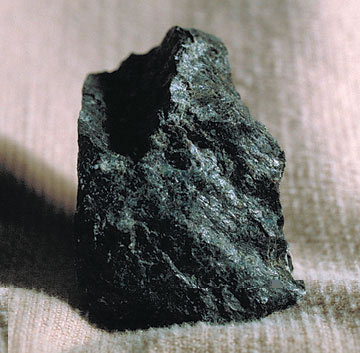
It can be pointed out here that the generic terms “serpentine” or “chrysolite”, as they are used in gemology, indicates not a mineral but a rock, because generally we are in the presence of many aggregated crystalline individuals and species. It would be more appropriate to define it as serpentinite, a rock basically constituted by minerals of the serpentine group (Figure 104).
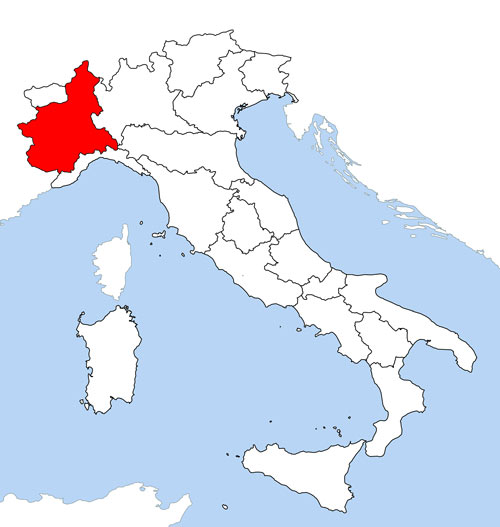
Specimens of serpentinite of gemological interest can be found in many locations of the alpine arch, because serpentinites are well represented in the Alps and across some sectors of the Apennines. It is sufficient to mention the historical mine of Balangero at the beginning of the Lanzo valleys in Turin’s province, for long time the largest open pit mine in Europe, from which compact serpentinite was unearthed to extract the percentage of medium and long fiber asbestos therein contained: in fact the fibrous variety of serpentine (or chrysotile or antigorite etc.) constitutes the material (now notorious) defined as asbestos.
As for manufacturing serpentine/serpentinite is mostly suitable for cabochons, small ornaments, slabs, boxes, knobs, handles for seals, in line with some shapes of jade. Above all Chrysotile, when showing its fibrous golden green structure, well organized in compact fibers, may originate an appreciable optical effect quite identical to chatoyancy.
Visit the Gems of Italy section!
Curated by the qualified group of expert of the section Gems of Italy, published on IGR – Italian Gemological Review #7, Summer 2019.