This content was first published on IGR – Italian Gemological Review no. 3 in 2018. The information provided here is therefore current as of the original publication date.

When, in 2016, the Federal Trade Commission, the historical American governmental agency regulating, among other things, the jewellery market as for the right terms and the fight against frauds, revised its guide lines after about twenty years, considered it possible to name diamonds as “cultivated”. Such attribute should have been followed by “laboratory-created,” “laboratory-grown,” “[manufacturer name]-created,” “synthetic” or by another word or phrase of like meaning. As operators know, the working method of FTC consists in taking suggestions from the involved parties. And it seems that there is a wide range of positions and proposals as far as terminology is concerned. For example, the Association Jewelers of America disagrees on the point: the cultivation would always imply an organic origin. The positions of 2015 ISO are on the same wavelength. Udi Sheintal, President of the Diamond Commission, has recently written a release on the matter. In line with clause 4.3.1.1 of the Blue Book, synthetic diamonds can not be named with an indication different than “laboratory created” or “laboratory grown”. According to CIBJO, inspiring most of the regulations, as a consequence, neither such attributes as the mere and only indication of the manufacturer nor the term “cultivated” are allowed. Moreover no abbreviations of these two terms can be used. The line followed by Sheintal considers as diamonds only the natural ones for which any further qualification is not requested. When we read “diamonds”, then, we should always expect natural gems. However, there is no unanimous agreement as, according to Sheintal: “Some in CIBJO are of the opinion that we will not be able to boost sales of natural goods by exclusively calling them ‘diamonds‘. Indeed, they say, by voluntarily relinquishing the use of the world ‘natural‘, we are in fact enabling sellers of synthetics to associate it with negative elements, such as the alleged impact on the environment, which in reality serves their purposes”.
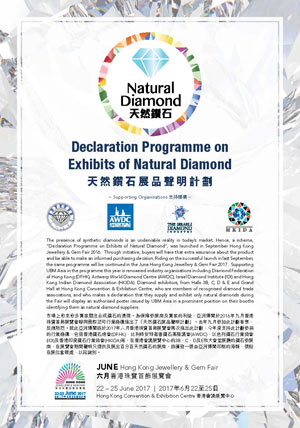
The game that is then played for the transparence and to defend the integrity of trade seems to pass from the field of the mere identification to that involving the proper terminology. But while physical data is irrefutable, the nuances in the dictionary can lead to ambiguities and disputes. For example, last September, UBM, organizer of the Hong Kong Jewellery & Gem Fair, asked the involved exhibitors to show a notice (see picture) to specify that their diamonds were “natural”. The commendable aim, considering the great confusion existing among emerging Asian countries in the consumption of diamonds, arose, though, the reaction of many industry Association (including CIBJO), according to which the attribute “natural”, would indirectly put “synthetic” diamonds in a position of equal importance. Diamonds are both natural and synthetic. It seems that the industry does not share the relinquishment of adjectives, as promotions are rich in attributes that are often the focus of the message. “Real is rare”, the campaign of the new shared marketing of big manufacturers put all emphasis on the attributes “real” and “rare” while diamonds, in order to avoid ambiguity with synthetic ones, are implicit. And on the synthetic front? Diamond Foundry, the company supported by Leonardo Di Caprio, manufactures synthetic diamonds that it calls “real diamonds”.
Gem News by Trasparenze News, published on IGR – Italian Gemological Review #3, January 2018.