This content was first published on IGR – Italian Gemological Review no. 7 in 2019. The information provided here is therefore current as of the original publication date.

Update 2023: This article was published four years ago on IGR – Rivista Italiana di Gemmologia – Italian Gemological Review No.7 (Summer 2019). Sergio Sorrentino, one of IGR’s long-time contributors, joined the mission organised by Martin Rapaport in October 2023 in Sierra Leone, one of the poorest countries in the world, where less than half of the population expects to live beyond the age of fifty. In this way he was able to see firsthand that the return for the community happened and it was concrete: schools, hospitals and aid for agriculture. IGR presented the details of Sergio’s mission on the ground. To better understand the economic backdrop of alluvial diamonds in Sierra Leone and the ethical efforts being made, we are publishing the background. A 709 carat diamond, discovered by chance and brought to market by Rapaport, started a virtuous process to help the country emerge from extreme poverty, devastated by a bloody civil war and hit by an Ebola epidemic in 2014.
The 709 carat diamond, Rapaport, ethics and auctions in Sierra Leone
In March 2017 a diamond made the headlines of international media. It was a 709 carat rough stone, the 14th largest ever discovered, unearthed in the alluvial diamond bearing region of Kono in Sierra Leone, one of the poorest countries in the world, where less than half the population have a life expectancy over 50 years.
What is going on, after the striking announcements? Have revenues been partly given back to support the region’s development? What has Martin Rapaport to do with this?

Underdogs at the bottom of the supply chain
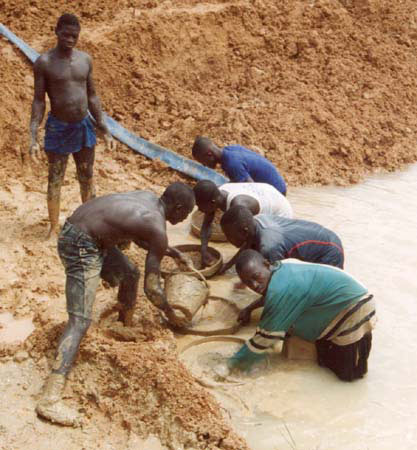
A group of diggers happened to find this giant diamond in a pit. They were working for Emmanuel Momoh, a “supporter” as locally they call organizers hiring people to search on their behalf.
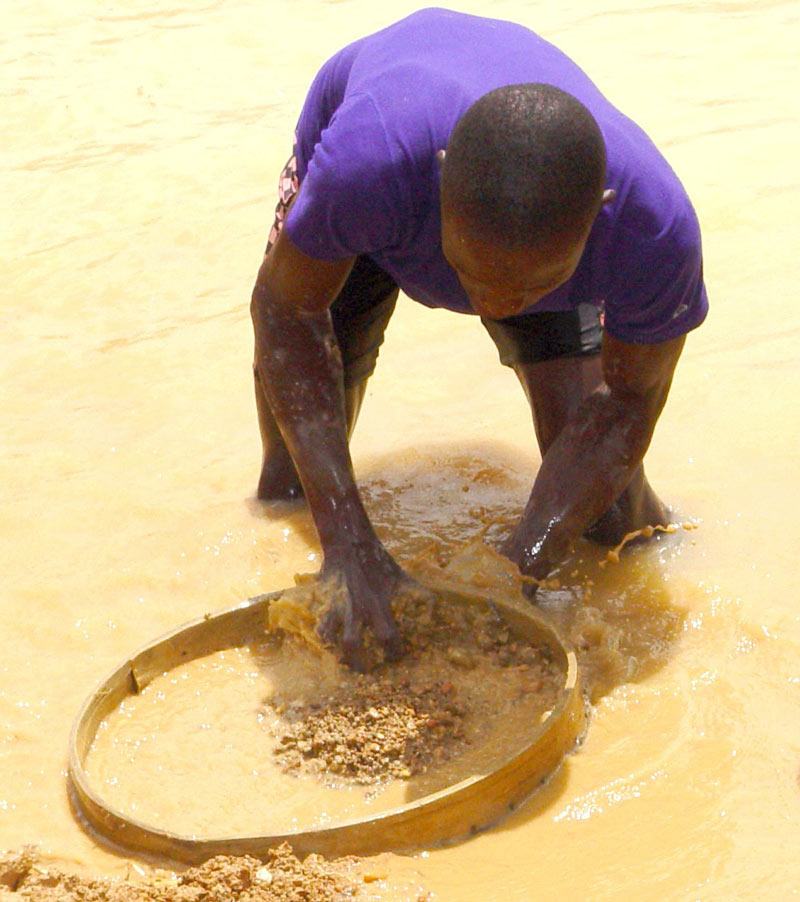
A “supporter” is a typical figure of the supply chain of Kono area’s diamonds. He recruits, for about US$2.50 a day, his own diggers, receives in return the material they find and brings worthy stones to local brokers who resell the rough gems to the wider market in Koidu, a city where the regional diamond trade is largely based, under control of merchants of mostly Lebanese and Marakas (French-speaking West Africans) origins. The weakness of these selling parties allow organized buyers to work as a cartel and underpay, frequently off the book, rough diamonds. The “supporters” and their team of diggers earn in cash for their livelihood an insignificant fraction of what the diamonds will fetch at the end of the chain as polished gems. This situation persists since decades, tolerated if not encouraged by the local and national establishment.
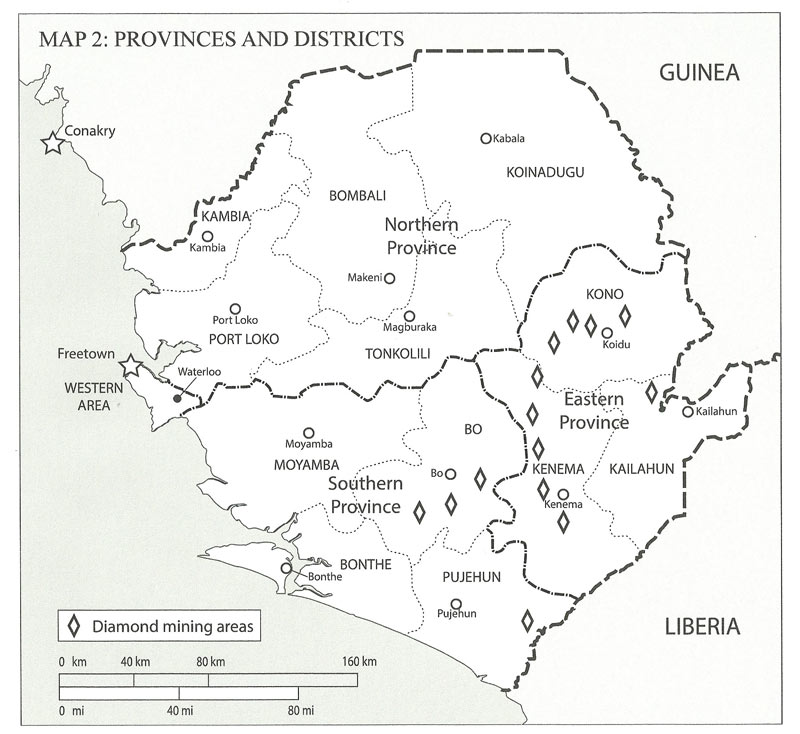
Contrary to countries where diamonds are found in deep kimberlite pipes and are exploited in limited and fenced areas thanks to huge industrial investments, Sierra Leone depends on alluvial deposits of material coming up to the surface, the source of 90 percent of its diamonds. They represent an affordable target for a large part of people. Volcanic eruptions oozed across the valleys of eastern Sierra Leone, embedding diamonds into a wide area.
This alluvial origin therefore results in scattered and unpredictable occurrences of valuable and less valuable diamond rough. In a scenery like this small groups of artisanal miners can try their luck at the cost of just some shovels and some inexpensive equipment.
Sierra Leone’s GDP is determined for more than half by agriculture and the industrial sector is nearly not existing. The country is desperately concerned with financing its development through natural resources. Iron ore (25%) as well as titanium (17%) offer a huge contribution to exports along with diamonds (12%), but the last figure is definitely underrated because most of the transactions elude the official statistics. Devastated by a bloody civil war and hit by an Ebola epidemic in 2014, the country is home to 300,000 to 400,000 artisanal miners and founds on diamonds its growth expectations.
The extraordinary diamond rough piece ends up in a Rapaport’s auction
Emmanuel Momoh is both an artisanal miner and a pastor of the local Church. For his breathtaking finding in 2017 he did not apply to the parallel market. He tried instead to use his stone beyond the written destiny of smuggling. He opted for the legal way and submitted it to Paramount Chief Paul Garba Saquee who addressed him to the President Ernest Bai Koroma, declaring: “The government wants people to bring their diamonds forward to discourage smuggling”. This was a good occasion to show the world that Sierra Leone did not deserve the bad reputation descending from the time Hollywood got inspired by its blood diamonds for the famous Leonardo Di Caprio’s movie.
Besides the government, under corruption allegations for over US$14 million missing from the country’s Ebola Fund, was just in search of good news and decided purposely to set up an auction in the capital city Freetown for the impressive rough diamond found in Koryardu, something never done before.
Surprisingly in May 2017, an offer of US$ 7.7 million from Ziad Al-Ahmadi, a British citizen, based in Antwerp and reportedly working for Raydiam BVBA, was rejected by Momoh who declared: “I’m expecting not less than US$50 million from the diamond”. So the government-supervised auction of the remarkable diamond did not result in a sale, though the President displayed it on TV several times announcing that the proceeds would be partly channeled back – as owner Momoh called for – to the poor community of Koryardu lacking electricity, running water, hospitals and any basic infrastructure.
After a second attempt in Antwerp, on October 2, 2017 the government of Sierra Leone appointed, as the marketing and sales agent for the gemstone, dubbed in the meanwhile “Peace diamond”, the international renowned Rapaport Group that auctioned it, free of any handling charge, in New York two months later. The best offer, amounting to US$6.5 million, come by the British high class jeweler Graff. The reason of this unexpectedly low bid, according to organizers, was the uncertainty of resulting color after the planned cut of the rough in a pear-shaped diamond larger than 100 carats with numerous other smaller diamonds, all certified by the Gemological Institute of America.
Sierra Leone is the place where the concept of ethical diamond originates
Martin Rapaport, the leader of one of the most powerful service providers in the diamond industry, envisaged in the auctioned giant rough gemstone a symbol representing what he considers an imperative step to be made by the industry as a whole in the direction of a more responsible business. His commitment to boost the diamonds of Sierra Leone through an ethical approach is not a surprise. It dates back to year 2000 when he was involved by U.N. in the peace process. A diamond specialist was a key factor to handle the consequences of the civil war that was basically about controlling the diamond bearing areas, working as ATM machines and fueling cash in the conflict. As the war ended in 2002, Rapaport tried to intervene again in the country in a USAID-funded Integrated Diamond Management Program and created cooperatives that rewarded workers with better wages compared to the wartime miserable conditions. This attempt, making Rapaport’s group a kind of greater “supporter”, failed because of too high investments that could not be paid back by too low return in rough gemstones.

Actually in those years the conditions of the easy to explore alluvial deposits, along with the post war political optimism, attracted the attention of many international institutions supporting the economical development of Sierra Leone. Even after the revolutionary introduction of the Kimberley Scheme, a transnational voluntary law, the ethical debate was confined to just CSR theory. It was time to take action and so the Rapaport Group took inspiration from this favorable context and introduced for the first time the issue of due diligence in the gemstone ordinary business practice. In 2006 the Fair Trade Diamonds project was launched by Rapaport in collaboration with the Germany–based Fair Trade Labeling Organizations International (FLO). This program was taken in the favorable wake of the successful initiatives based on coffee, cocoa, sugar, flowers, rice and other raw material sold in compliance with fair and responsible policies supporting local communities of developing countries under ecologically friendly conditions.
Morality can make the world a better place. Voluntary contributors to this human aspiration are legitimating a new value addition, the ethical one
Martin Rapaport’s pragmatic approach to Fair Trade is evident in Sierra Leone more than a decade ago: “You don’t have to be an idealist. You can be interested in Fair Trade Diamonds if you are a greedy pig. There is money on the table here”. In a few words, ethical reasons are not limited just to morality, but they concern the creation of a brand new value, the value of responsibility: “I know it sounds crazy”- he said – “but if we tell consumers there are diamonds that make the world a better place, there are rich women in California who will pay extra for that”.
Fair Trade initiatives require an active role by NGOs which preferably work in the agricultural field and are reluctant to intervene in the diamonds value chain operating in difficult countries like Sierra Leone. So other subjects started programs in support of the alluvial diggers, like the Diamond Development Initiative (DDI), whose members include Rapaport, De Beers, the International Diamond Manufacturers Association and several NGOs. In March 2019 DDI, after a seven year experimentation in Sierra Leone, started the “Maendeleo Diamonds” (Maendeleo is a Swahili word meaning development), a certification scheme for diamonds from alluvial deposits that can be considered as being mined in conflict-free zones through violence-free operations that respect both human and worker’s rights and use practices that are environmentally responsible. In connection with this initiative in April 2019 De Beers set up a program consisting in a digital platform.
Rapaport Group’s ultimate proposal. Auctions supporting local people
As far as fungible and stock listed commodities such as coffee and other agricultural goods are concerned an effective ONG-supported Fair Trade policy is relatively easy to put into effect. It can focus on the legitimacy and integrity of determined producing regions, their environmental conditions and their relations with local communities. The stability of the commodities’ prices are not a problem of producing parties. The case of alluvial and scattered diamonds of countries like Sierra Leone is a different story because prices are still negotiated piece by piece, only a small percentage of value remains to the country and an even smaller one goes to miners.
Martin Rapaport faced this crucial bottleneck, an obstacle on the path to possible development of supporting strategies. He treasured his past experiences while working there for as long as two decades. After a preparation work involving two of his sons, in April 2019 he led a trade mission of 29 international diamantaires and jewelers to Sierra Leone, to present a proposal to the government that, according to him, could optimize the country’s diamond industry. The model is based on the actual organization of artisanal mining but now diggers and “supporters” would take their stones directly to a countrywide network of weekly auction centers, accessible to both licensed and unlicensed diggers but restricted to authorized buyers only, which the Rapaport Group would help set up. This would reward, under the Sierra Leone Mines and Minerals Act of 2009, all local stakeholders, from diggers to government, with a fair market value for diamonds. The law requires that 60% of the value of the diamonds shall be given to the government. A provision ensuring that 25% of the 60% (i.e., 15% of the value of the diamonds) goes to the communities where the diamonds were found.
By the way, has anything been returned to the village of Koryardu after cashing US$6.5 million for the impressive 709 carat rough gemstone? The churchman, Emmanuel Momoh, reportedly was promptly paid by the government for his share, about US$2.5 million and passed to his five diggers about US$130,000 each. It seems he made his part donating similar contributions to Kono’s church and local authorities and invested for himself in real estate about US$1 million.
This is what happened with the US$ 6.5 million
Reports from the area of Kono show the villagers in a mood of frustration and impatience because the Peace Diamond still had not paid off for them while the government promised new roads, a medical center, a school, improvements in their poor infrastructure. Emmanuel Momoh is disappointed, nothing came back from Freetown. “If the government doesn’t fulfill its promises, I think that it will break the trust and people will not take their diamonds to the government any longer” he said.
If returns do not materialize in tangible things at the bottom, there will be no ethical value at the top of the chain. This is badly affecting Martin Rapaport’s plan to institutionalize the Peace Diamond model that was conceived, according to him, in the spirit of “Tikkun ‘olam”, a kabalistic notion that has come to connote a social action taken with the intention of making a “repair of the world”. Before the ethical benefits will be evident and useful to “fix” the complex situations related to developing economies, there is plenty of work to do with regional governments, local communities, international institutions, industry, organized traders, cartels and, last but not least, miners.
Article by Domenico Angelino, published on IGR – Italian Gemological Review #7, Summer 2019.