This content was first published on IGR – Italian Gemological Review no. 7 in 2019. The information provided here is therefore current as of the original publication date.

Let us summarise. Three years ago, Swarovski, the giant company specialised in custom jewels, announced its debut in the world of synthetic diamonds. And this could have been easily imagined, given the excellent reputation acquired in the industrial cutting of synthetic stones, but also, to a lower extent, of natural ones. But now, during the latest edition of JCK in Las Vegas, Nadja Swarovski makes public, in a panel on sustainability, that, in 2020, it will enter the market of natural diamonds. They will obviously make use of sustainable sources executing in Austria, with few exceptions, the whole manufacturing process starting from rough to polishing of finished goods.
The emphasis on integrity and responsibility was a card already played by Swarovski in 2016 with its first synthetic diamonds. At that time, the first line of lab-grown items called “Diama” presented synthetic stones as “socially aware and conflict-free” diamonds, a move to gain a competitive advantage on the natural ones. Today Swarovski displays its own synthetic diamonds on its site with the name “Created Diamonds” and shifts the emphasis on the democratization of luxury, in brief: to each woman her own diamonds. Moreover, Penélope Cruz, movie celebrity and humanitarian activist, has been ambassador of the latest launch of a “sustainable jewellery” collection since last month.
Many observers wonder why a company like Swarovski decided to turn from synthetic to natural diamonds when, for over a century, imitation stones have been one of the core business of the Austrian Group: glass and lead “crystals” characterised by an excellent make and with a formula that is still treasured today. The global turnover evidences a continuous growth, but the “crystal” sector still accounts for 77% of the total € 3.36 billion. This is probably a preventive diversification, meant to avoid the loss of shares of its piece de resistance to the benefit of new Asian competitors. And for such a scenario, synthetic diamonds may not be enough after the launch of Lightbox by De Beers and the subsequent drop of the prices of the melee produced with the HPHT method.
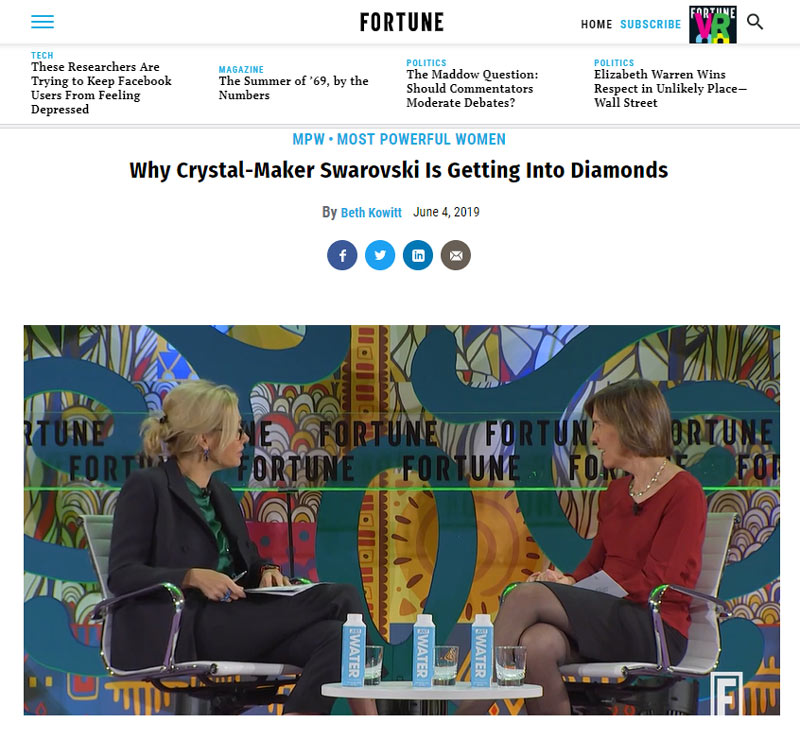
During the Fortune Most Powerful Women International Summit held in London on 4th June 2019, Nadja Swarovski confirmed the strategy of the Austrian company that basically relies on the power of its brand appeal that is thought to be working for both synthetic and natural diamonds: “We are totally for everything that sparkles. The minute you are able to mine the diamonds, sustainably, we will be your customer”. It is practically as if they said: laboratory created diamonds are accessible to everyone, the natural ones are eco-sustainable and both are signed and responsible.
Gem News published on IGR – Italian Gemological Review #7, Summer 2019