This content was first published on IGR – Italian Gemological Review no. 6 in 2019. The information provided here is therefore current as of the original publication date.

Obsidian is a natural glass and is considered a rock. Its name reveals ancient origins and Plinius named it “lapis obsianus” in honor of a certain Obsius who brought it from Ethiopia. The first written mention is referable to Herodotous who reports a sharp stone, of Ethiopian provenance, used in Egypt to extract the bowels of the deceased people during the mummification process. But obsidian was already known in prehistoric ages as it was among the first materials extracted by the man to produce sharp cutting artifacts, such as knives (to cut food), scrapers (to clean skins), axes (to cut trunks), or arrowheads (for hunting).
Obsidian is a rhyolitic glass of volcanic origin. During certain eruptions the low temperature of rhyolitic magma may be overheated and therefore, deprived of phenocrysts, it can lose completely the dissolved gases. If, while fixing, fast cooling inhibits the crystallization of magma, this vitrifies. The absence of gas prevents it from blistering. So obsidian forms in a few cases, in outer submarine eruptions of domes or lava flows, within the duct and in rare subaerial flows.
Although it is generally clear, obsidian is hardly ever transparent because of its extremely dark color. The sole variety fit to faceting comes from Ethiopia, exhibits a dark brown color and presents gassy bubbles as typical inclusions. In most of its deposits obsidian is black, in certain cases grey or slightly greenish dark and it appears transparent only in thin sections. Black obsidian is mainly used in jewelry as a base for doublets or as the edge for inlay works. The number of known deposits is currently immense. In most cases obsidian is a cheap stone.
In Italy we have one of these rare casts erupted by the Rocche Rosse crater of Lipari. Obsidian is named Liparite after it. Actually in Lipari the most beautiful specimens don’t come from the flow but from a deposit of pumiceous tuff in which huge blocks of black obsidian are found, torn off from the volcanic duct during the eruptions (Figure 76). This obsidian has been a very valuable raw material across the Neolithic age and has been marketed in bulk all over the Mediterranean.

Other obsidians come from Monte Arci, in Sardinia, from the island of Pantelleria (Sicily) and from Palmarola (Lazio).
Obsidians from Sardinia can be found on the southern foothills of Monte Acri (Figure 77), near the village of Pau, Oristano province, regarded as the village of obsidian, the black gold of Pau, where the Museum of Obsidian has been recently inaugurated.

In Sardinia the deposits of obsidian are numerous, four at least, and the nice mahogany red brick striated variety can be encountered there.
Obsidian of Pantelleria is located along the southern cost of the island in many small outcrops. This obsidian contains tiny white phenocrysts, presents a typical greenish color when thin layers are observed backlight and shows traces of its fluidal groundmass. This is why it is named “Blade of Grass” in the area where it is used in local production of handicrafts (Figure 78).

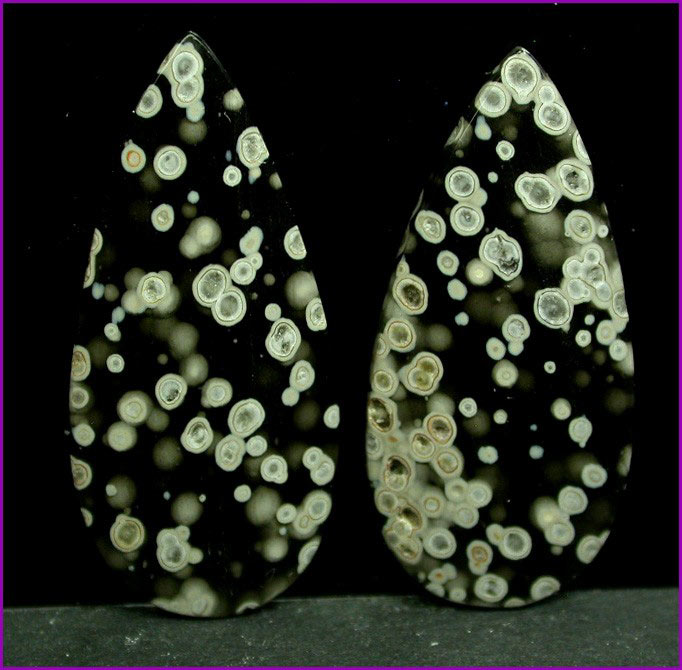
A nice variety of obsidian from Lipari is marketed under the name of “Cosmic Obsidian” containing small devetrification spherulites. This rare variety is suitable to be cut resulting in attractive stones (Figure 79) and abroad it is currently the most well known Italian gem quality obsidian.


Visit the Gems of Italy section!
Curated by the qualified group of expert of the section Gems of Italy, published on IGR – Italian Gemological Review #6, Spring 2019.