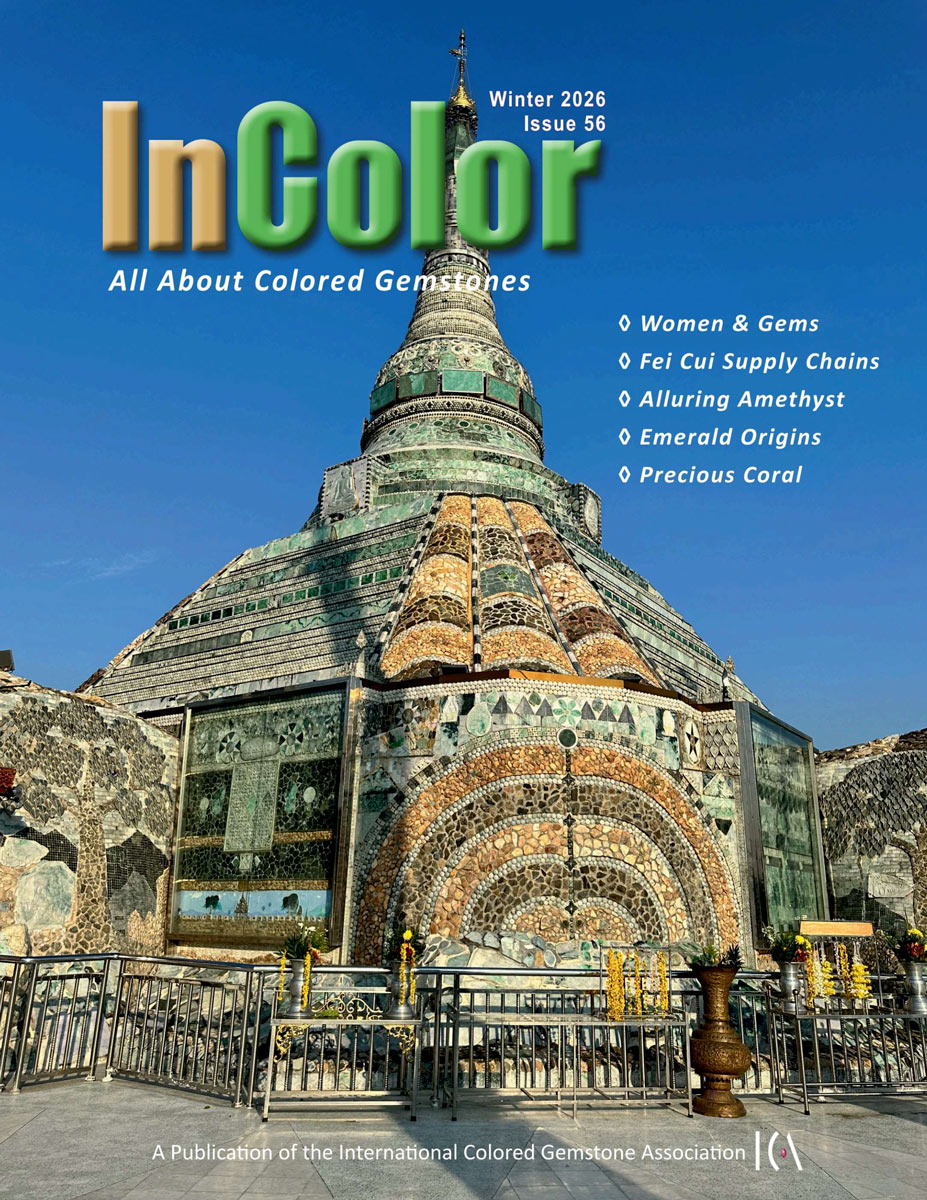
With issue 56, InColor Magazine — the quarterly publication of the International Colored Gemstone Association (ICA) — offers an in-depth feature that intertwines laboratory research, an analysis of global supply chains, and a historical-commercial rediscovery of gemstones that are now central to the market.
The issue opens with “Determination of Emerald Origin Through the Identification of Solid Inclusions” by T. Rozet, V. Fejoz, A. Arsac, M.P.H. Curti and W. Oei, a study that tackles one of the most complex questions for modern laboratories: determining the geographic origin of emeralds. Conducted at Bellerophon Gemlab in Bangkok, the study is based on an impressive dataset of 1,628 samples (0.17 to 43.61 ct) analyzed using high-resolution digital microscopy (up to 2500×), Raman spectroscopy, and UV-Vis-NIR spectroscopy.
A key interpretive pillar is the role of ferrous iron, observed through the absorption band at 825nm, which makes it possible to separate emeralds into two broad categories: the low-iron type, which includes deposits such as Colombia (Muzo, Chivor), Zambia (Musakashi), and Afghanistan (Panjshir), and the high-iron type, broader in scope and represented by origins such as Brazil, Ethiopia, Russia, Pakistan, and Zambia’s Kafubu area. This spectral framework becomes a “map” for correctly interpreting inclusion markers, helping to avoid assigning geographic significance to indicators that, on their own, could be ambiguous.
The most innovative part is the systematization of solid inclusions: the authors catalog 114 mineral species according to the Strunz classification, with silicates as the largest class (51 species). This yields highly specific provenance indicators, including 34 minerals found exclusively in a single deposit. The work also highlights a crucial point for laboratory practice: common minerals such as quartz, calcite, and apatite do not “make origin”, but they are valuable for natural-versus-synthetic diagnostics, because they have never been identified in synthetic emeralds.
Next comes the update by A. Lucas, R. Liu, and P. Gao, “Fei Cui Global Supply Chain Research – Update”, from the Guild Field Gemology team, which takes the reader into the heart of the jadeite (Fei Cui) market — an industry that, in China, surpasses diamonds and pearls in volume. The report describes a post-pandemic transformation they call revolutionary: the market in Mandalay, Myanmar, is now dominated by Chinese livestreamers who broadcast negotiations and sales live via smartphone. Purchasing becomes instantaneous and heavily image-mediated: decisions on rough material are made “almost in the dark”, relying on video footage, flashlights, and real-time impressions. Traditional trade does not disappear, but it is clearly outpaced in scale, speed, and competitive pressure by the new digital ecosystem.
The article “Rediscovering Spinel: A Legacy Reborn”, by R. Jain, presents spinel as an emblematic case of reappraisal — from a gemstone historically confused with ruby to a protagonist of a contemporary renaissance. The article traces the centuries-old misunderstanding — exemplified by the famous “Black Prince’s Ruby”, in fact an untreated red spinel in the British Imperial State Crown — and notes that only in the 18th century did crystallography enable a clear distinction, thanks to the different atomic structure. Today, its commercial strength comes from qualities perfectly aligned with modern demand: authenticity (spinel is almost always untreated) and durability, with a hardness of 8 on the Mohs scale, making it suitable for everyday wear without compromise.
InColor 56 confirms that contemporary gemology is an integrated system: the laboratory increases the precision (and defensibility) of determinations, while the market reshapes itself under digital pressure, redefining speed, value perception, and the geographies of supply. InColor no. 56 (Winter 2026) is available on the official website