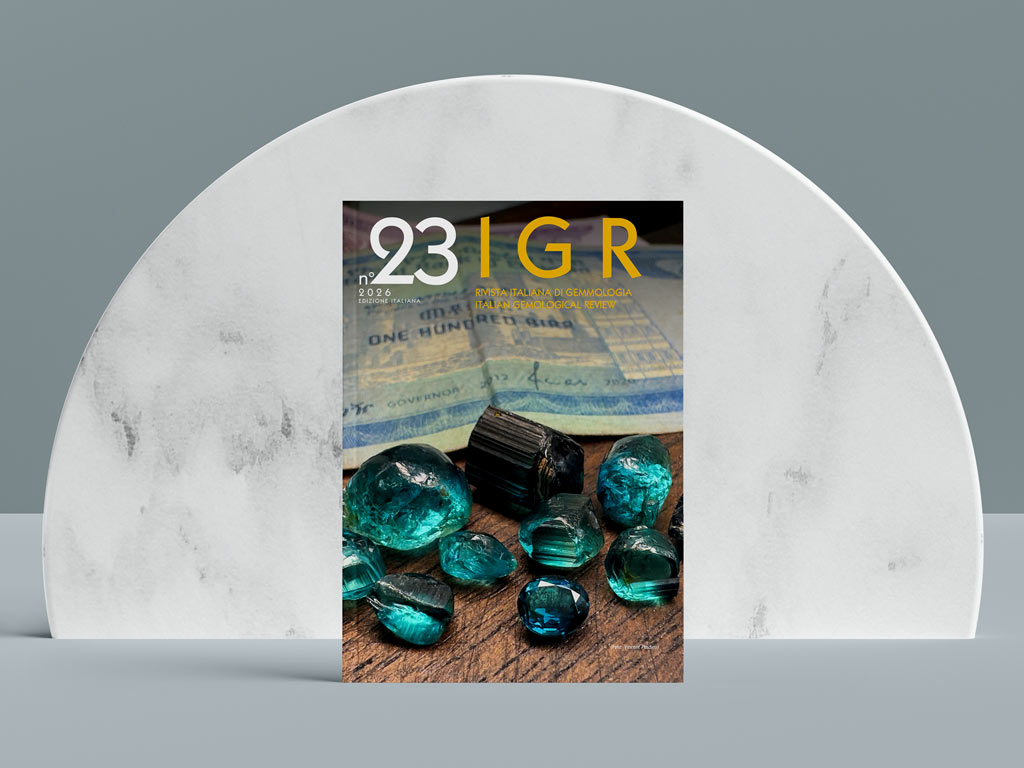
This content was first published on IGR – Italian Gemological Review no. 23 in 2026. The information provided here is therefore current as of the original publication date.
Vincent Pardieu (VP Consulting) is a field gemologist with 159 expeditions for the survey of gem-bearing deposits that virtually cover the entire globe. For 25 years he has documented global mining conditions, specializing in the origin determination of rubies, sapphires, emeralds, spinels and many other gemstones. He has worked as a buyer in Myanmar, served as AIGS Lab Director, Gübelin gemologist and Senior Manager Field Gemology at GIA, where he built one of the world’s finest reference collections.
Pardieu co-authored a report published by IGR on these very pages that provides the first scientific indications on the tourmaline discoveries in Ethiopia. He also contributed to the first report conducted on the Abuloo mining field by Haimanot Sisay, an Ethiopian gemologist, with the help of geologist Léonard Cornuz and published online by IGR.
IGR: SSEF recently announced the discovery of blue tourmalines in Ethiopia, and the news spread within days. Does this race to be first risk encouraging sensationalism or even imprudent communication?
Vincent Pardieu: Communication from laboratories — even commercial ones — should be careful, and scientists are not supposed to publish rumors or engage in sensationalism.
A few years ago, Ken Scarratt who was then my boss at GIA told me that the important thing is not to be the first to publish something, but to be the first to publish something correct and useful. Then as in scientific publications, authors are expected either to present their own findings or to give proper credit to the person who first published on a given subject, being the first to publish provides a clear advantage in terms of visibility and recognition.
One of SSEF competitor told me (with a bit of jealousy) that «SSEF World class at trying to grab a maximum of exposure with the minimum of evidence» as they often communicate after getting simply told something by a customer.
IGR: What’s your perspective in this specific case?
Vincent Pardieu: My perspective is that this is probably a consequence of their former challenger position compared with older and better-known laboratories such as Gübelin and GIA. Because their name was not initially as widely recognized, they worked hard to publish early in order to gain greater public recognition.
That “publish first” approach, even if it’s annoying to other researchers, is perfectly acceptable as long as the published information is based on verified facts. However, I noticed that they rarely double-check their sources as thoroughly as I would do and sometimes present hypothesis that will be later proven wrong.
I suspect this applies to the blue tourmalines from Ethiopia as the preliminary studies from us and DSEF of samples coming reportedly from that new deposit goes against the hypothesis presented by SSEF that tourmaline from that new source will be very difficult to separate from those from Brazil. In such cases, this can become problematic.
Note: On many aspects SSEF is one of the best labs in regard of colored stones but in my opinion they could do much better if they adopted a more mature and careful attitude in term of communication and sourcing of “reference” samples.
IGR: Arriving first, in short, does not mean arriving in the best way. What characteristics should a field expedition have if it aims to support a proper scientific study?
Vincent Pardieu: Arriving early at a new mining site is always the best scenario, as it provides the opportunity to document the exact location of the deposit and collect reliable data, including samples, photos, videos, interviews, and field notes.
Such information can then be used to prepare a proper field report. This is what Haimanot Sisay, an Ethiopian gemologist, did with my help and that of geologist Léonard Cornuz who was her classmate at GIA. She was not the first person to reach the new deposit, but she was the first to take the time and effort to collect meaningful information and publish a report.
IGR: Who in the industry can afford it in terms of time and costs?
Vincent Pardieu: The main requirement is to have someone qualified, honest and trustable able and willing to collect good data. In my opinion, this is something that almost anyone in the industry can afford to do: field expeditions can be organized in collaboration in order to share costs.
This is what I do since 2005 when the labs I work for agree. In the end, it all depends on the laboratory management, and where they choose to allocate resources. The main reason some laboratories do not do this is because they don’t see direct benefit from it and because many people working in labs are also probably more conservative and not really as adventurous as people like me. I’ve to say that I met many lab gemologists who prefer their lab coats to muddy boots.
IGR: Your preliminary research indicates the Abuloo deposit yields «a chemically heterogeneous population of copper-bearing tourmalines». What should we generally expect from a new tourmaline deposit?
Vincent Pardieu: Tourmaline is one of the most complex known minerals, both in terms of structure and composition. In “The Fundamentals of Mining for Gemstones and Mineral Specimens”, Jim Clanin, one of the most experienced mining engineers in the field of gemstone mining, describes tourmaline as «the garbage basket of minerals», because it can accept almost any element from the periodic table as an impurity within its structure.
Indeed, tourmaline is one of the minerals that forms toward the end of pegmatite crystallization, incorporating many of the elements still available in the system. Furthermore, during formation, some elements may become depleted, meaning that the composition of the first tourmalines to crystallize in a given pegmatite commonly differ significantly from those forming later. In that context, what should be more surprising is not heterogeneity, but homogeneity.
IGR: What are the realistic prospects?
Vincent Pardieu: My experience with gem mining is that it always involves a significant element of gambling, as it is very difficult to predict the quality of the gems a given deposit will produce.
But among all types of gem mining, pegmatite mining was regularly described to me by geologists and miners as the most unpredictable, because from one pocket to another, the situation can be completely different.
IGR: Given that the boundary between elbaite indicolite and elbaite Paraíba is chemically subtle yet economically decisive, could SSEF’s excitement-driven announcement have pushed traders to invest significant sums on potentially premature conclusions?
Vincent Pardieu: Yes, it did. The press release suggesting that the stones from the new find in Ethiopia were very similar to Brazilian Paraíbas motivated several buyers to rush to Ethiopia and invest in stones that were later identified as indicolite.
I know one of them: luckily for him, the largest stone he bought should get Paraíba from most labs, but this will not be the case with most of the other gems in the parcel he bought.
IGR: Here at IGR, we like to play the devil’s advocate: isn’t there still a secret hope among traders that the spectral fingerprint of these Ethiopian stones might match the Brazilian ones closely enough to grab a market bonus?
Vincent Pardieu: That sounds very likely but you should ask that question to dealers.
IGR: As a leading voice in field gemology, grounded in the scientific collection of data, you have quoted John Emmett: «There’s only one thing worse than no data, and that’s bad data». To what extent does this explain why origin determination studies can remain intrinsically fragile?
Vincent Pardieu: Well, the main issue with origin determination as it is done today is that the trade satisfies themselves with opinion given by labs that are more or less qualified to provide these opinions.
This creates a culture of mediocrity within labs who don’t have to prove that they have done any serious research as they are just expected to give an opinion based on their experience. Hence the numerous conflicting reports.
IGR: The question on many people’s minds is: will we ever be able to determine the origin of gemstones?
Vincent Pardieu: As technology advances in regards of some colored stones, I believe that, if the right research efforts are done, it will be possible to identify the origin of most of the gems in the trade, as long as:
- the lab invests in a complete and reliable reference collection and keep it as up to date as possible;
- the lab dedicates some resources to data collection on that reliable reference collection.
But I’ve to say that sadly so far, outside of GIA and Guild (lead by my former colleague at GIA Andy Lucas), I did not hear yet about any program like that.
IGR: Ethiopia is already being described as a new “El Dorado”, but few people consider the impact on local communities. How could responsible origin determination generate concrete benefits?
Vincent Pardieu: My understanding is that some people on the ground have already benefited from that new discovery as they were able to sell the stones they found (often with a minimum of investment) for a fortune.
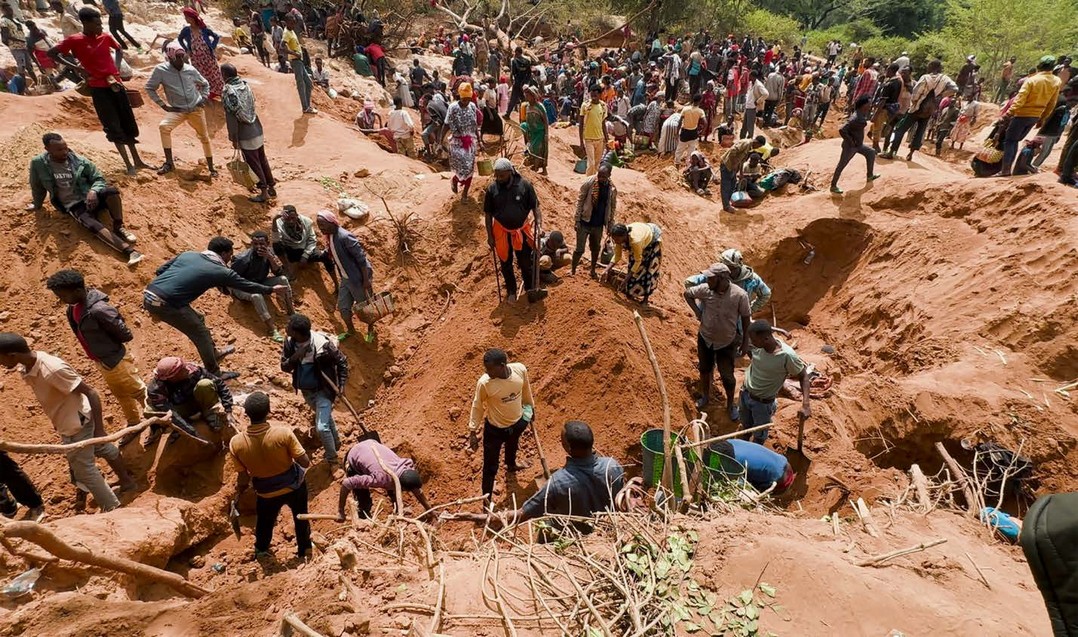
So, the economic spill is real (but it is limited to few lucky or smart people). So real that many people stopped their work in coffee plantations, gold mines, emerald mining or even office work in town to move to Abuloo to try their change into what I call the “gem casino”.
IGR: Villages springing up from nothing. Can you tell us about other sudden “gem casinos” you have witnessed?
Vincent Pardieu: I have had the privilege of witnessing many “gem casinos”, from Namya in Myanmar to Ilakaka, Andilamena, Didy, Zahamena and Bemainty in Madagascar, Kataragama in Sri Lanka, Winza and Matepwende in Tanzania, and Montepuez in Mozambique.
Some of these rushes were short-lived, while others are still ongoing. About the later type, Ilakaka, is a good example. For the past 28 years, it has hosted almost every year several small, short-lived rushes across a wide area.
Other rush areas were nearly deserted after only a few months, but later experienced smaller rebounds when new discoveries were made. In most cases, some people found valuable stones, became wealthy, and invested wisely enough to significantly improve their lives. Others are less careful and lost everything they had gained within few years or months.
We should not forget that California and Alaska started with chaotic gold rushes (Canavesio and Pardieu, 2019, https://hal.science/hal-02551427).
IGR: After the rush and speculation, what is left for the most fragile territories?
Vincent Pardieu: Many journalists and activists often like to focus on the chaotic or sensational aspects of such rushes. However, in many cases, it is not as bad as they like to show and gem mining provides employment, brings infrastructure to remote areas and stimulates development overtime as we can see in Ilakaka.
What began there with a few huts along the roadside has developed into the main town in the region, becoming a pole of attraction for education, services, security, and economic opportunities for many people from surrounding villages.
So, regarding Abuloo, as the size and the potential of that new deposit is still a mystery, the only thing I can say it that time will tell.
IGR: At the 2025 Naples Conference of Gemmology, you raised a key question: is a shared, scientifically curated mineral reference collection achievable, or will the field stay fragmented under AI-driven, proprietary lab protocols?
Vincent Pardieu: Here again: time will tell. But I think that one of these days the change will come from the consuming side when a big brand decides that their definition of being responsible could be “to know what they buy and what they sell” and will invest in some internal lab (or quality control department) using science and origin determination as a reliable tool to double check their traceability investments.
IGR: Could consumer pressure drive bottom-up change? Could a major, consumer-sensitive brand replace current origin labs with a scientifically robust protocol and gain social responsibility advantages?
Vincent Pardieu: Yes, if at the end of the chain big jewelry houses feel that they would benefit to have some in-house expertise about the gems they use instead of relying on independent labs, things could change.
The real game changer is that unlike for diamonds, science provides reliable solutions in regards of origin determination for most colored stones if somebody does the necessary research efforts. I say most as of course there will always be the case of that unknown deposit that was never studied.
These solutions could be very useful where traceability finds its limits. And science will continue to progress, so I’m very confident that science will become at the end the most reliable solution to find out where gems actually come from.
Article by IGR, published on IGR – Italian Gemological Review #23 – Autumn 2026.