




This content was first published on IGR – Italian Gemological Review no. 10 in 2020. The information provided here is therefore current as of the original publication date.

In between June 24 and 26 the international media were flooded by the iconic image of Saniniu Laizer, 52, a former Tanzanian herdsman, married to 4 wives and father of 32, showing a dummy check worth 7.7 billion Tanzanian shillings (US$ 2.1 million). The photo is intended to clearly demonstrate that the local government is actually returning to the people the revenues gained by the mineral wealth of the nation. There is no doubt that the facts behind the picture are stunning enough to raise an international concern resulting in sensationalistic headlines across the world.
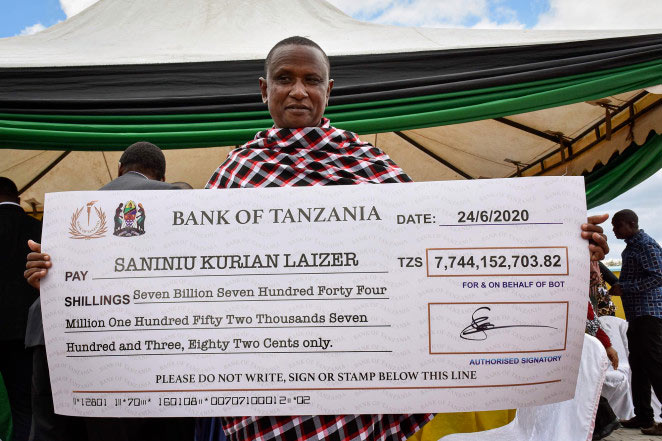
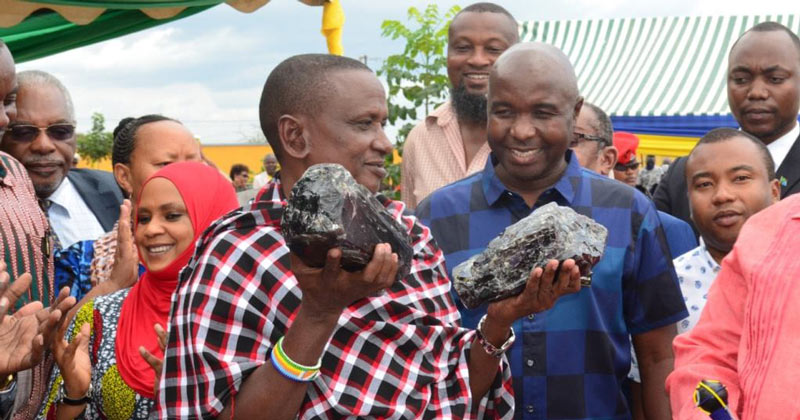
A former herdsman miner discovers million-dollar crystals of tanzanite. Here the story begins
But Laizer is not a poor and hungry lonely miner scraping the soil, poorly equipped with a shovel and makeshift means, as some media have depicted him. Possessing sufficient capital earned by his previous job, he took a chance into the tanzanite mining business. This means that he works as an investor and he’s not directly involved in the underground operations; his workers do the job receiving no salary in return but just food, basic lodging and, most importantly, a share of the production. It’s a challenge. They bet and sometimes they win the lottery.
Slicing the earth’s crust at a remarkably deep underground mining pit, they discovered in June 2020 two impressively big tanzanite rough pieces weighing 9.97 and 5.1 kilograms. Each of them was sold to the government. The lucky underground surprise did not end there though. In late July a third specimen for the equivalent of 2 million US$, weighing over 6 Kgs was unearthed and also sold to the Tanzanian government.
The facts are well known worldwide due to the amplification of the media which insisted on the emotional appeal that such news have on readers. An ordinary man from a remote place, wrongly described as supposedly being extremely disadvantaged, is a symbol of the whims of fate, a kind of underdog who overnight becomes a millionaire.
Yet to the experienced analysts of Tanzanian economy as well as to tanzanite specialists, this atypical deal between the selling artisanal miner, and the Tanzanian government, as the buyer, reveals more implications worth to be accounted for.

President Magufuli sends a nice check. Resource nationalism and consensus building
It’s a matter of fact that the story openly reflects more a new direction in the politics of this African country than the stroke of luck of a common man who suddenly becomes wealthy.
Under the Presidency of John Magufuli, elected in 2015, the Tanzanian economy underwent a 180-degree turn in focus, from the more free market-driven policy carried on before him to a more state-driven management. The effects of these changes are evident in the mining sector which represents 23.7% of national GDP and includes tanzanite as a significant contributor. Interestingly, just at the beginning of his mandate President Magufuli proclaimed that the country had been cheated for long by unfavorable mining contracts with foreign partners and by the continuous erosion of wealth caused by smuggling as well as by underrating the value of exported raw materials. That was the time to give back something to Tanzanians in return for political support.
He has therefore embarked on a policy that experts refer to as “resource nationalism”, a political attitude that claims that, when it comes to exploiting the mineral wealth, national interests must be placed before any international speculation.
This new new game pursues economic development through a wide public support and the creation of consent. In this game it’s essential to show that the state is committed to remunerating artisan miners by purchasing the most notable specimens they happen to unearth. This is why the strategy of President Magufuli is based on pictures like those posted and published by the international press representing tanzanite miners while they are receiving money that until recently was smuggled away from the country.
Big business vs. small miners but the cutting industry is missing. How to exploit tanzanite?
Tanzanite is a young gemstone whose exploitation dates back to the late sixties. Its occurrence in the entire planet is restricted to the Tanzanian Merelani hills in Simanjiro District, a limited area originally subdivided in 4 blocks. The history of exploitation is based on both small scale mining (ASM) and large mining operations (LSM), basically carried out by a private South African company (AFGEM, then Tanzanite One since 2003) to which the concession of a full block was granted.
Inevitably, a competition broke out because of the capitalization gap, a giant miner vs. small activities. Underground intersections among the blocks also provoked controversies and fights. Additionally the South African industrial group was able to introduce its gemstones as responsibly sourced and traceable. Such a competitive advantage, indeed only partially rewarded by the market, on the contrary pushed ordinary miners into the arms of foreign brokers, ready to sustain their sales with cash payments. Surprisingly, according to regional press reports, Tanzania is only at the third place by value, after India and Kenya among the largest exporters of its supposedly unique tanzanite gemstones, a consequence of the absence of cutting facilities and frequent smuggling.
Fight against smuggling, the Tanzanite wall is born
In an attempt to gain control over its poorly managed mineral wealth in 2010 a Mining Act was promulgated allowing in 2013 the State-owned Mining Company (STAMICO) to take a 50% share in TanzaniteOne, an unfruitful move since its production has been declining starting from 2014. It is significant that during the 2015 election campaign Magufuli pointed his finger at TanzaniteOne and promised to confiscate possible “idle” tanzanite mining plots and redistribute the concessions to artisanal miners. In 2018 TanzaniteOne was brought to the court for not payment of salaries to most of its employees.
Was Magufuli’s economic nationalism effective, at least as far as tanzanite is concerned? Certainly the facts undeniably show that the impetus given to the mining sector and in particular to tanzanite has continued. 2017 has been a decisive year since a new legislation banned the export of all raw minerals and gemstones, while a Parliamentary Committee, established on the purpose, reported that 80% of tanzanite was irregularly sold to avoid taxation. A tanzanite-specific law was also called for, establishing a centralized state-owned tanzanite mining company, which until now didn’t come up.
In between September 2017 and February 2018, the entire tanzanite mining area was isolated by the erection of a 24 km wall President Magufuli ordered the military to build. The wall, reportedly, had a cost of US$ 2.9/3.5 million and presents a single military controlled entrance/exit where at a checkpoint governmental specialists carefully examine the tanzanite rough determining its market value and fix the royalties to be paid on the spots.
Commentators emphasized that this new resource management system is merely focusing on duty collection rather than on the implementation of a definite development plan effectively supporting the tanzanite mining companies. Official figures show that artisanal miners such as the lucky man, Saniniu Laizer, are contributing to total tanzanite royalties for nearly 87%. So they are essential to replenish the national revenues that recorded a 714.5 million TSh (US$ 308,000) unprecedented high in the first quarterly of 2018, more than what the government collected in the previous three consecutive years. The oscillation of production, however, is a knotty problem as the second quarter of 2018 shows disappointing figures (40 million TSh, US$ 17,000) to recover again in 2019.
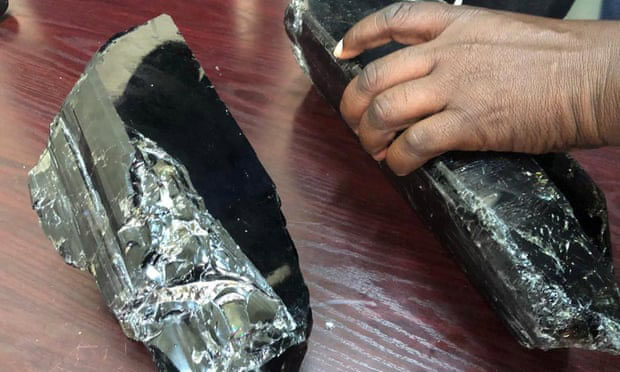
Ok, the government buys the exceptional pieces but the new system does not take off
While government again lashed out against the alleged resumption of smuggling, observers notice that the fall in production is definitely possible for many other reasons such as the lack of infrastructures and the increase of operational costs. For example the new wall forces miners to provide separate transport vehicles and equipment inside and outside the restricted area. Additionally, auctioning tanzanite in Mererani instead of Arusha proved to be less an effective regional development strategy and more a risky move due to the lack of adequate infrastructure. Also it has never been possible to retrieve at least a part of the remarkable value addition provided by the cutting industry that escapes the country and is located far away in India and Thailand.
Geology tells us that underground tanzanite occurrence is unpredictable and so far no support has been given by the national geological survey to provide more detailed data. In the meanwhile miners are forced to work at increasing depth and at higher costs.
From March 2019, only 7 per cent tax (and zero royalty) is levied on small scale tanzanite mining, in an effort to improve the performances that have not been as good as expected, inasmuch as new election time is approaching and Mr. Magufuli is aiming for a new mandate precisely on the basis of his resource nationalism policy. It’s still early to assess to which extent this strategy benefited the economy though it is evident that President Magufuli is attempting to present the interventions in tanzanite mining as political gains identified in his personal commitment.
Article by Paolo Minieri, published on IGR – Italian Gemological Review #10, Autumn 2020


