This content was first published on IGR – Italian Gemological Review no. 6 in 2019. The information provided here is therefore current as of the original publication date.

“Pietra Paesina” is an all-Italian stone available in many locations of the Apennines, from Piedmont to Lazio and particularly along Tuscan Appennines near Florence.
It is a limestone that offers landscape-like designs when cut as slabs. Therefore it is a soft stone suitable for inlay works on furniture, boxes and ornaments as well as for beads, carvings and cabochons. Using this stone cut in cabochon or beads but also as buttons or watch-case, recently an important industry of silver jewelry developed.
The Medicean Opificio delle Pietre Dure in Florence used it since the second half of 16th century when it was known as stone of Florence. Paesina is also at the base of Florentine Mosaic in which paintings are reproduced through the use of various kinds of inlaid stones.
Pietra Paesina is encountered in layers 10-30 cm thick within formations of distal flysch. They are calcareous turbidites within a pelitic sequence. These layers behave more rigidly than pelites containing them and therefore form micro fractures due to load during diagenesis. Later, an infiltration of iron and manganese oxides determines the color of the stone starting from the edges of the block, while the original colors remain in the not oxidized core exhibiting grey and light blue tones that evoke skies or pools of water (Figures 80 and 81).
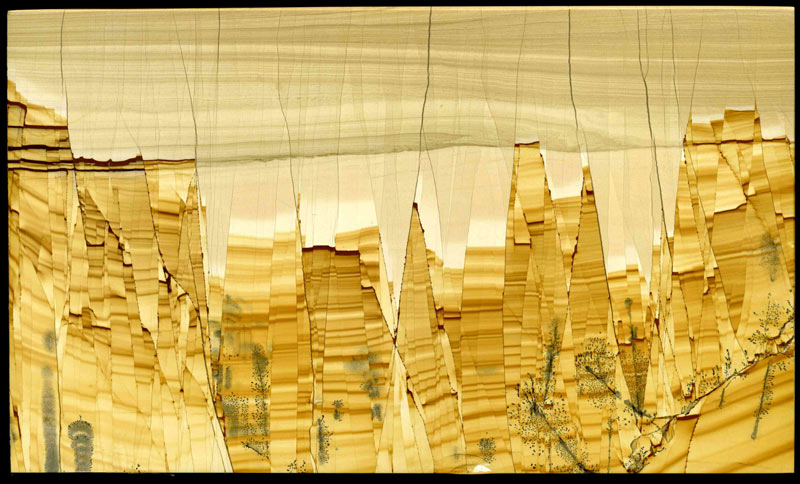
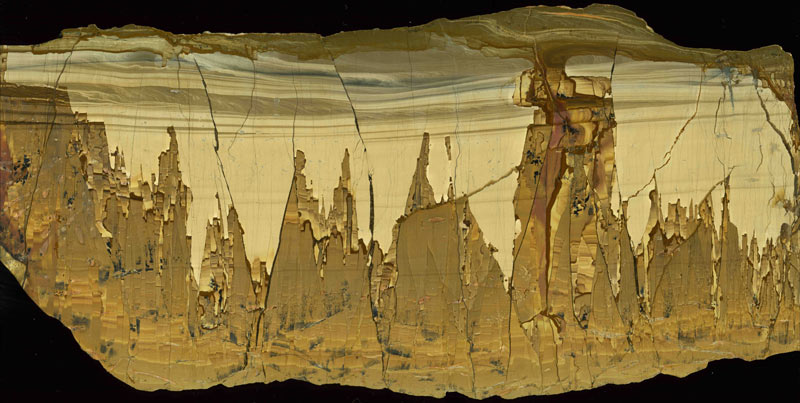
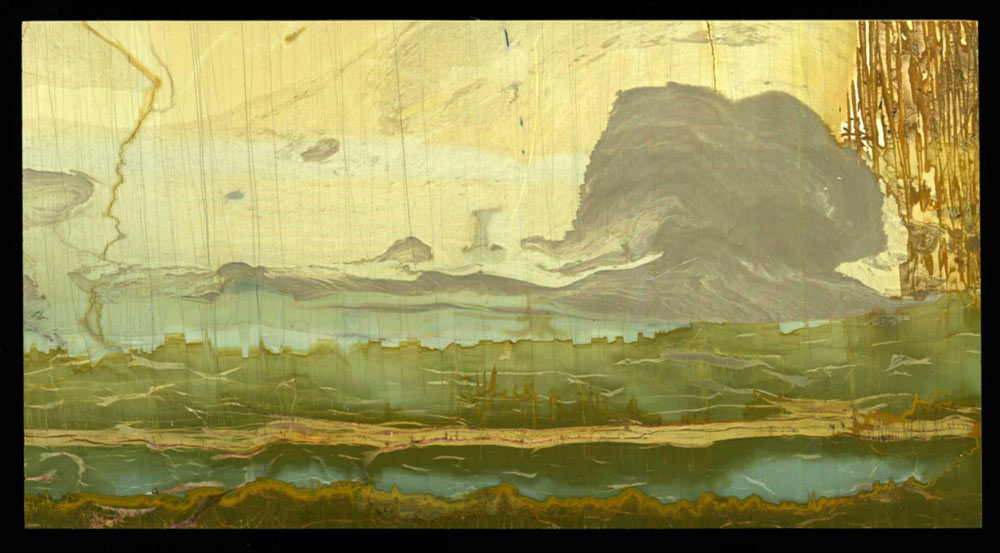
After the highs, recorded in the eighteenth and nineteenth centuries, when Paesina was exported all over Europe as an ornamental stone for rich bourgeois Palaces, it at the end fell into oblivion, possibly because of the exhaustion of Rimaggio, the main quarry, close to Arno.
But at the beginning of the seventies an old man carrying a heavy backpack of Paesina blocks was found dead in the woods of Monterifrassine. His name was Ferdinando Innocenti, nicknamed “il Rossino” and he was found to belong to a family of diggers passing each other the secret locations of the most valuable Paesina, the one with blue sky and clouds.
The Green of Arno is considered a variety of Pietra Paesina but actually it has nothing in common with it if not the locations in the surroundings of Firenze. It is again a limestone occurring in this case in floated pebbles and not in layers. Its design is geometric among the micro-fractures of the limestone generally randomly oriented (Figure 82), while Paesina shows vertical and more or less parallel fractures.

The predominant colors are green, yelllow ochre in the direction of the edges of the blocks and light grey in the middle. Coloring in this case occurs when the pebble was already rounded in the river beds, while in the case of Paesina this process happens in situ when the layer was still submerged in the bedrock.
On the other hand, to both stone hunters and workshops using it, the history of Verde d’Arno has been always associated to Paesina.

Visit the Gems of Italy section!
Curated by the qualified group of expert of the section Gems of Italy, published on IGR – Italian Gemological Review #6, Spring 2019.